


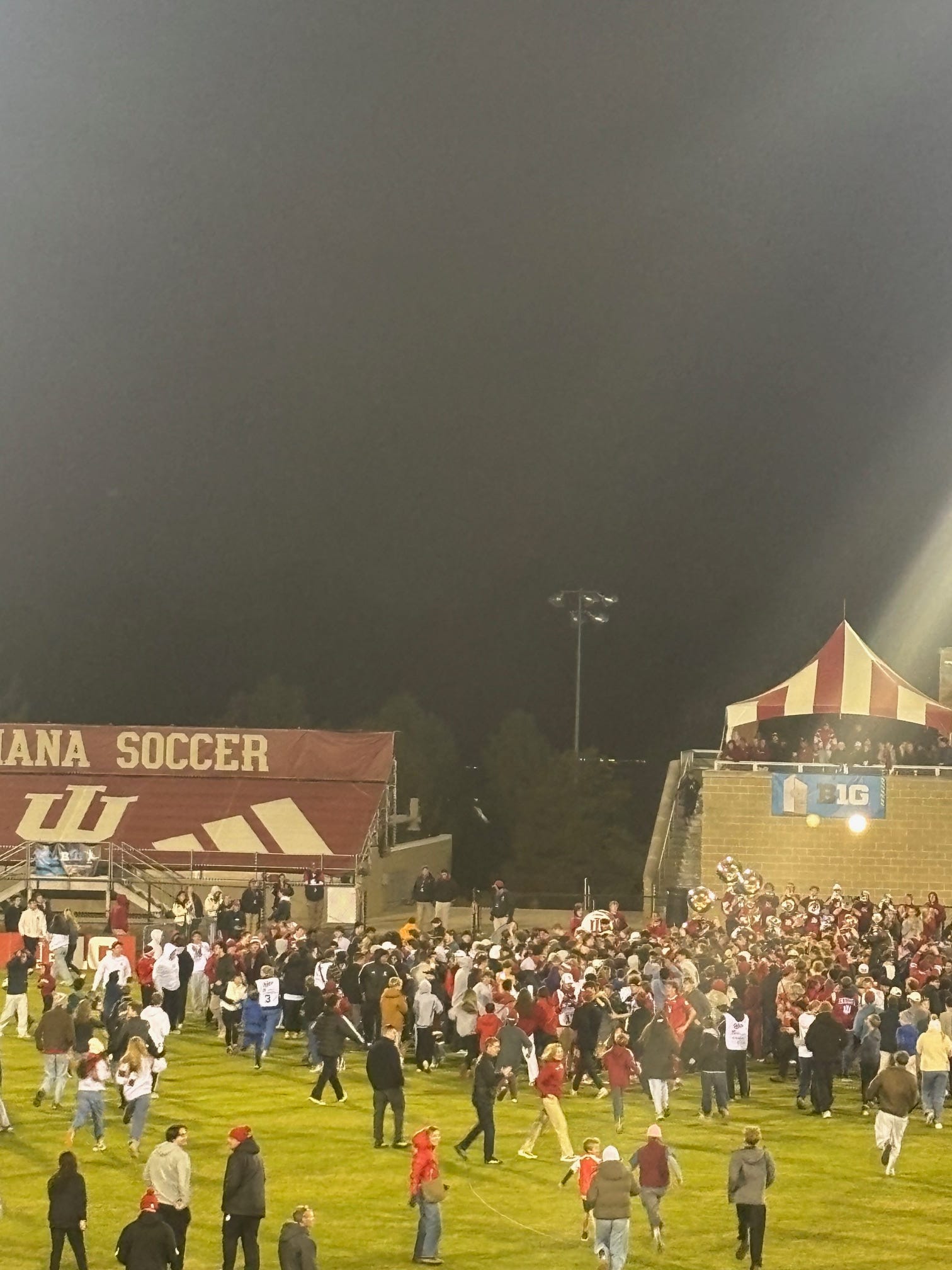
IU Fans Rush Field After Conference Championship Last Weekend
BLOOMINGTON — If you tuned into Indiana’s match in the NCAA Men’s Soccer Tournament this weekend, the product on the field looked noticeably healthier than it has in years. Passing is cleaner. Defenses are organized again. Mature, battle-tested goalkeepers are making genuine, full-stretch reaction saves instead of giving away routine goals.
Granted, college soccer is never going to be confused for the World Cup, yet there is a massive difference between a structured, high-level amateur match and a chaotic track meet. Watching top programs like Indiana play disciplined, high-tension soccer feels like watching a real match again—a welcome relief after half a decade of wide-open, no-defense track meets that dragged the top of the sport down into the same frantic style mid-majors have always played and made every game look like target practice.
On paper, the bracket looks familiar, too. Traditional heavyweights like Indiana, Maryland, Georgetown, and Clemson are back on top, joined by Sun Belt powerhouse Marshall, while the random mid-major anomalies that dominated the RPI over the last few seasons have mostly faded.
Do not let the scenery fool you, though. College soccer has not healed its underlying problems. It simply went on a nice vacation, put a fresh layer of gauze over a bleeding wound, and took some flattering photos in front of a cosmetic ocean backdrop.
To understand where the sport actually sits right now, you have to look at how we got here. Over the last decade, Major League Soccer’s Homegrown pathway and European academies emptied out the top of the American college pipeline. True five-star domestic prospects sign pro deals at 15 or 16 and never step on a college campus. Even when elite talent arrives, it rarely stays more than a year or two.
That talent drain left power-conference programs scrambling. For a few chaotic years, mid-majors exploited a market inefficiency by recruiting older, 22- and 23-year-old international academy players, turning the NCAA Tournament into a coin-flip lottery where random mid-majors could crash the party and even win it all.
Recently, the major conferences fought back—not by fixing the developmental pipeline, but by turning mid-majors into their personal scouting department. Every spring, Big Ten, ACC, Big East, and Sun Belt programs raid the transfer portal to poach the best proven stars mid-majors discovered, from All-American midfielders to conference Goalkeepers of the Year like Indiana’s Michal Mroz. Unlike college football or basketball, where the portal is a luxury used to grab late bloomers to complement five-star freshmen, working the portal in college soccer is pure survival. High school commitments are non-binding lottery tickets, so pooling the best remaining upperclassmen and second-tier internationals onto one roster is the only way top programs can assemble a competitive spine.
That consolidation worked as a short-term fix. By gathering the best veteran defenders, holding midfielders, and keepers onto a handful of brand-name rosters, top programs restored order to the hierarchy. Lower-tier teams that try to play open against them get punished again, forcing underdogs back into deep low blocks for the first time in years. Goals-against averages are down, chances have to be earned, and late-game mistakes carry real weight again.
Yet even the best teams today sit a clear tier below the pro-caliber squads of a decade ago, and the entire equilibrium rests on a temporary patch. Holding gauze over an untreated wound is risky, especially when the sport refuses to address the real issues waiting back home.
Right now, college soccer is like a couple in a troubled marriage who goes on a tropical getaway, enjoys a genuinely wonderful week together, and mistakes temporary peace for a fixed relationship. The NCAA’s new seeding format—expanding to 24 seeded teams while displaying regional 1-through-6 labels—serves as the picturesque ocean backdrop in those vacation photos. By turning overall seeds 17 through 24 into regional “No. 5s” and “No. 6s,” the bracket softens the optics whenever a top heavyweight falls early and creates the visual illusion of a balanced, healthy hierarchy.
Meanwhile, the actual marriage remains broken. Power-conference programs with pro-level facilities and budgets are still governed by the exact same compressed fall calendar, unlimited-substitution rules, and one-vote legislative system as low-budget mid-majors. Just weeks ago, Division I schools voted to rescind the 21st Century Model—a long-fought proposal that would have spread the season across both the fall and spring semesters to reduce midweek congestion, improve player recovery, and align college soccer with the professional calendar—largely because smaller programs balked at the added staffing and operational costs. That vote proved how thoroughly mid-major budget concerns can block reforms that top programs desperately need, trapping major powers in an outdated model that disconnects them from the rest of global soccer—a disconnect that will only widen when MLS shifts its calendar.
Turning to the match Indiana played Sunday, the fact that Missouri State had to “park the bus” and pray to reach penalty kicks showed that the dividing line between mid-majors and the Power Five is somewhat back. While the 0–0 grind was frustrating to watch, the fact that Indiana no longer needed to run a track meet that pinballed back and forth with no defense is an immediate improvement.
Against the brick wall of the Bears, Indiana created only a couple of good chances it missed in regulation, yet controlled the game and was never in danger of conceding a goal. IU appeared to have avoided PKs twice in the final 10 seconds of double overtime, only for a video review to negate a late foul before a goal by Stephane Njike with one second left was ruled offside.
IU coach Todd Yeagley said he does not blame the officials, despite the fact Njike was judged to be in front of the ball when video potentially said otherwise.
“Its hard,” Yeagley said. “Everyone has different technology and their doing their best. We’ll take what we have now. Its still better then no reviews. We’re not putting the blame on the officiating.”
However, Mroz once again gave the Hoosiers an advantage in the kicks, saving Missouri State’s fourth attempt while Indiana converted all five to move on. Having Mroz between the pipes gives IU an undeniable edge in shootouts, and the team has now won two straight in that situation with him in net.
Mroz said he definitely feels like he gives his side the upper hand without sounding brash.
“Not in a cocky way but yes,” Mroz said “I know some people can’t take the pressure that the moment expects. I go into it like every other situation like its practice and for me I don’t feel the pressure at all.”
On Indiana’s side, the Hoosiers had to make all five to come out on top and did—including one by seldom-used Luka Bezerra, the brother of former IU star Victor Bezerra. Despite limited minutes this season, Bezerra buried his with no problem.
Bezerra said he looks to his brother for confidence.
‘‘I think the first thing that comes to mind is practice,” Bezerra said. “Having a brother like Victor helps you practice at a different clip. When you watch me and my brother go down to train, every rep as trained as if it was in the game so nothing changes, it allows me to step to the moment extremely confident. Having a brother by your side like Victor who is my best friend helping me progress is an unbelievable feeling.”
With the win, IU will face Washington a third time this year next weekend in the Sweet 16 after the Huskies beat West Virginia in Morgantown on Sunday night. While beating an equally matched side yet again is never easy, the alternative of playing an elite Mountaineers squad with a stingy defense that had not conceded a goal in over a month until the Huskies’ late game-winner may have been more daunting.
Make no mistake: Washington has an elite attack that has burned the Hoosiers before. However, scoring on them is definitely possible, and yet another high-scoring game is well within the realm of possibility.
It should be noted that in 2020, Indiana was taken to PKs—and won—by a mid-major St. Francis-Brooklyn squad that packed it in, before controlling matches against Marquette, Seton Hall, and Pittsburgh to reach the title game, ultimately falling in a heartbreaker to Marshall. While playing the Huskies will not be easy by any means, a more open game against power teams from here on out that offers more chances to score and be scored on has its advantages.
For now, the Power Five has reasserted its dominance early in the tournament, and it has made for better games as a title is chased. However, the sport is still not in a great place.
Until top-tier college soccer separates from mid-majors to build a pro-aligned, two-semester model that actually attracts elite domestic prospects back to campus, every watchable November is just another pleasant getaway. Enjoy the soccer this tournament, and enjoy the drama of the chase—just remember that when the trophy is handed out in December, the blood is still soaking through the gauze underneath.
_____________________________________________________________________
Wow, really good in-depth article! Oh, and Go Hoosiers!