


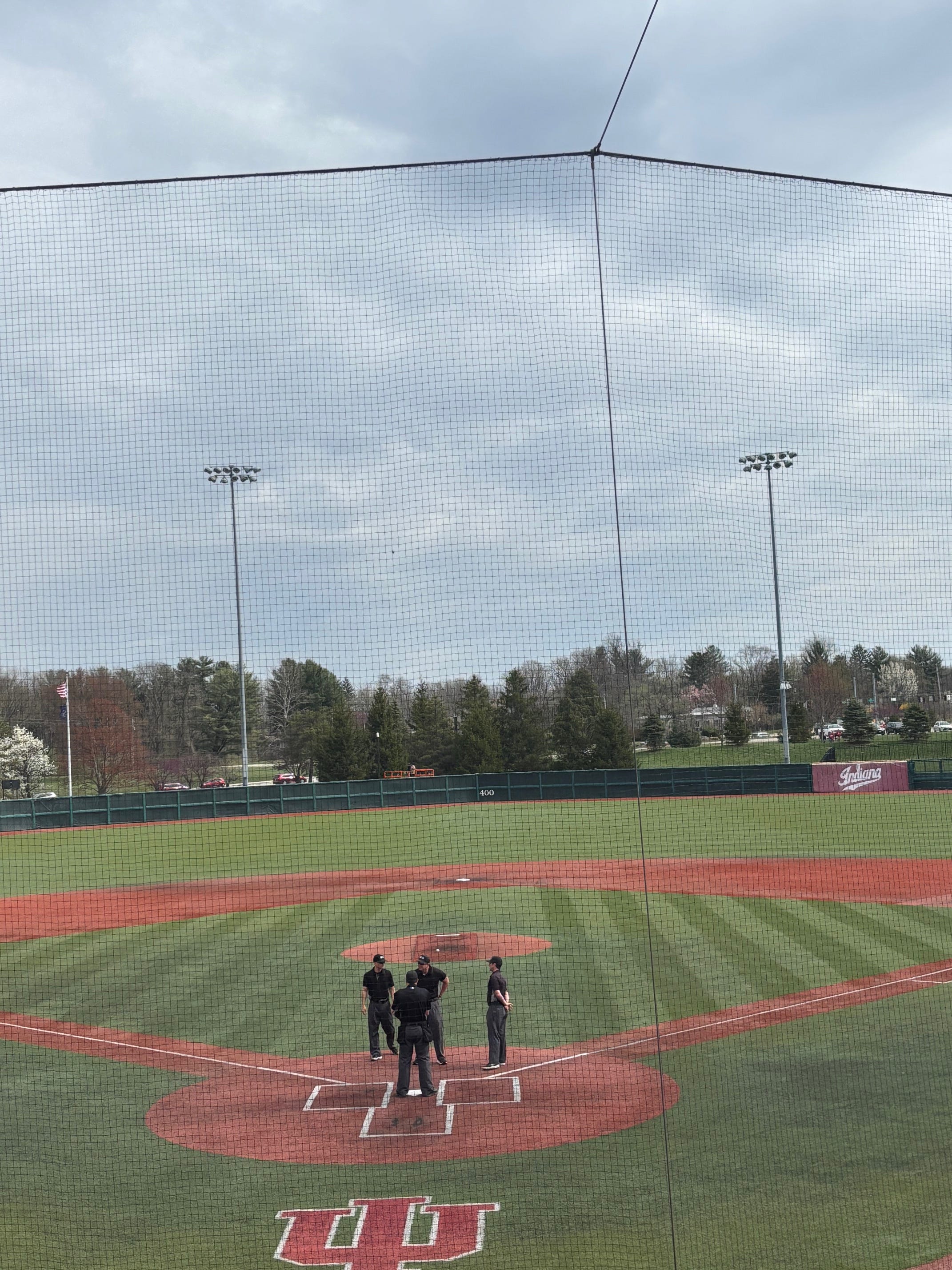
Bart Kaufman Field In Bloomington Where Indiana Plays Its Home Baseball Games
It’s mid-July, and the longtime Bloomington Limestones are a Single A squad in the MLB Minor Leagues that use Bart Kaufman Field in the summer to develop talent and play as all the boys of summer do. Fans love the squad, and it has sent multiple pros to the next level. However, the humble beginnings for these prospects are with the Limestones, where the players made mistakes and grew up before our eyes, while results didn’t matter. The fans who come every year under head coach Jeff Mercer love the relationship with the squad and enjoy the $1 hot dog promotions and fireworks on a beautiful Friday night.
It’s a beautiful utopia of a baseball factory. The only problem? The Limestones don’t exist, and it is what Mercer has now created with IU baseball, essentially.
Back in the real world, the Hoosiers are not the Limestones, and they compete in the Big Ten in somewhat unpredictable spring weather, and results do matter to many fans and alumni who see the IU logo on the jersey. Unfortunately, this is the conundrum for a program that has sent 31 picks, including 17 pitchers, to the draft during Mercer’s tenure, which is now in its eighth season.
While the development is top notch, it often seems player development trumps winning in Mercer’s world. Despite having all these pros, the results on the field are much less successful. The team has not won the league since 2019 despite having the best talent during this time. Furthermore, they have made an NCAA Regional just twice in the last seven seasons during Mercer’s tenure, and one of those invitations was slightly controversial with athletic director Scott Dolson on the selection committee for a bubble squad.
This comes after going to the postseason every single year between 2013 and 2019, save for 2016. Also, the program went without a losing record overall in a single season between 2008 and 2021. Now that 2026 has concluded, it is the second time in the past five seasons that the final standings have the squad below .500 for the entire year and towards the very bottom of the league.
Furthermore, IU had not missed the conference tournament since 2011. Now, even that impressive streak comes to an end as the decline in results continues.
The disconnect in the results is the previously mentioned 17 pitchers drafted, yet team ERAs are generally near the bottom of the conference. Also, an above average amount of defensive errors at the wrong time always seem to occur. This leaves fans to wonder if the radar gun and analytics that pro scouts prioritize are more important in Bloomington than the raw results on the field.
This is not the first time an experiment of this kind in college seems to prioritize development over results. For IU fans, they need to look no further than three hours south to another basketball-first school in Lexington. However, for this university, the disconnect was on the court with John Calipari in that place’s primary sport.
Calipari famously told Kentucky fans that his greatest achievement was the number of players he sent to the NBA, not the number of trophies he put in the case. While this model worked for a while, it eventually led to the end of his tenure when Wildcats fans got worn out over results not matching talent.
It should be noted that college baseball is not college basketball, and the pressure to win on the diamond is much less. However, this does not mean fans enjoy what is going on at IU, where results not matching talent have led to increasingly diminishing attendance, even on nice weather days.
It should also be mentioned, though, that there seem to be sections of the fan base who do show up still and don’t mind the current model. However, for casual Hoosier supporters, this player development first mentality will not come close to filling Bart Kaufman Field.
Contrast this with what is across the street at Andy Mohr Field. Here, softball coach Shonda Stanton has built a program no one before her has managed to do since the 1980’s in that sport in Bloomington. While the talent may not be as high, the results are top notch, and an identity and culture have been built based on elite power and stealing bases, which has resulted in yearly postseason appearances. The joy and energy seen in the dugout here are also palpable as every pitch is thrown.
The question for Mercer here is what identity or culture he has created outside of getting players to the pros. This is the situation the athletic department will have to consider, and whether that is enough to stick with the current regime. It is a safe option in the NIL world where every dollar saved can go to sports that produce more revenue than Big Ten baseball does, and Mercer’s lab is working exactly as he intends.
Mercer emphasized they are developing players to be pros as part of the college baseball cycle.
“We’ve had 9 or 10 pitchers drafted,” Mercer said. “We lose a lot of guys to the draft and most pitching staffs are running six to nine games out on a weekend. You have your “A” group, and you are trying to develop that next group. We have to continue to recruit and develop.”
It comes down to whether creating a minor league experience of development first is compatible with a college atmosphere. This is the decision facing IU athletic director Scott Dolson this summer, and there are certainly arguments either way on where to go.
Mercer and his staff are arguably the best technical ‘heart surgeons’ in the college game. They can fix a pitcher’s spin axis with their eyes closed and have their players time up and crush pro prospects’ fastballs like no one else. But being a Big Ten head coach is brain surgery—it’s about the whole system, the culture, the weather, and most importantly, the scoreboard, where hitting off speed college pitching is equally important. The administration will have to ask if they’re paying for surgeons when they need general doctors.
An argument can be made either way, and it’s an unenviable position to be in. However, when you have the college ball Hoosiers and not the fictional Single A Limestones, it’s a decision that must be made carefully.
If IU decides to make a change, though, there is an ideal candidate sitting over in Oxford, Ohio, at Miami University, 90 miles to the East. His name is Brian Smiley, and he is a 41-year-old Indiana Native who spent many years under two of the most respected coaches in the game, Rick Heller and Mitch Hannahs, at Indiana State. Since taking the job with the RedHawks, he has turned them around into conference elites for the first time in a couple of decades and got them back to the NCAA Tournament.
What happened 20 years prior, though, is why he is such a perfect fit. This is the last time Miami (OH) was a relevant mid-major under a guy every Hoosier fan has heard of by the name of Tracy Smith, who built IU into a Big Ten power from ground zero upon taking the job.
Between him and Terry Hoeppner, Bloomington has had good luck with guys from this University, and Smiley could be the latest. This contrasts with schools in Dayton (Wright State and University of Dayton), which are always mid-major powers, and coaches here have seemingly struggled at the next level between Archie Miller and now Mercer. IU has spent too long looking for the next ‘Golden Child’ from the Dayton monopoly. It’s time they returned to the Oxford blueprint if it is decided that a change in leadership is needed.
There is an argument to be made that the Hoosiers are the best job in the Big Ten Conference outside of the West Coast schools and Nebraska. Given the much milder spring weather than other Big Ten programs and the lack of competition from an MLB squad, Bloomington offers the only program with this combination, along with the Cornhuskers, that is not on the Pacific Coast. They also have a relatively new stadium in Bart Kaufman Field that Smith ensured got built less than 15 years ago.
Again, if this were the Limestones, Mercer would be the ideal guy, and the decision would be easy if he were the right man for the job. However, as a college baseball program, results seemingly matter to many fans, and right now, a noticeable decline in winning is occurring despite all the talent brought in and pros being churned out.
Mercer emphasized his plan of development as his staff come from pro organizations who would like them to return there later.
“You look at (former pitching coach) Dustin Glant that has been here the last four or five years is in the big leagues now,” Mercer said. “(Current pitching coach) Matt Myers was the minor league pitching coach of the year for the Pirates. (Assistant Coach/Pitching & Catching) Denton Sagerman every professional organization in the country calls and tries to hire (him).”
All of this seems to lead to the conclusion that Mercer is a baseball development savant in a manager role who knows analytics like the back of his hand. The question is whether Indiana is OK with this in the context of college sports, where rosters are always transient and wins are arguably paramount.
_____________________________________________________________________
Terrific analysis. As a casual fan I’ve wondered why IU has struggled in baseball. This makes sense. Watching Purdue excel this season while IU sinks to the bottom of the conference is frustrating. It’s more fun to win.
I have think IU needs a change