


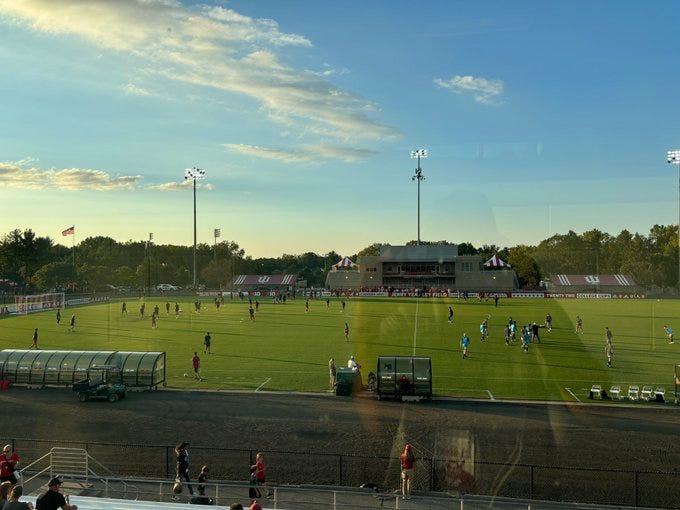
Armstrong Stadium, Where The Soccer Match Was On Thursday Evening
Soccer’s 2026 Season Starts With A Bang, But IU Must Prevent Last Year’s Whimper
BLOOMINGTON — First off, I am back for an eighth season covering Hoosier sports for Assembly Call. While I may not be able to cover quite as many games as in the past, I still plan to write about a handful of matchups throughout the IU athletic season. I also apologize for the late start compared to past years; I was on vacation out of the country when the action got underway.
Turning our attention to the pitch, Indiana is now 3-0 after a 1-0 win over Butler in their third match of the season. The 1-0 score line does not reflect the dominant nature of the home side. Indiana outshot the Bulldogs 33-2 in a match where the opposition sat back and absorbed pressure, parking 9 to 10 men behind the ball for the majority of the night.
IU coach Todd Yeagley said Butler’s strategy may have been more about the game flow then intentional
“I don’t think that was out of design,” Yeagley said. “I think they tried to get after us and press and we just had that much of the ball. If you’re playing the shape they play they are going to naturally to get five on the back line which will get you a little deeper.”
With the victory, the IU soccer team has gotten off to a fast beginning. This quick start is the complete opposite of traditional seasons under Todd Yeagley, when results typically came more slowly early on before a fast finish led to a deep run in the NCAA Tournament.
Last fall, the script flipped: the Hoosiers started strong but struggled as the year went on in conference play, ultimately exiting the NCAA Tournament in the second round. It was their earliest tournament defeat when chasing a title since 2014. It is imperative this time around that the quick start holds up if Indiana wants to secure a College Cup appearance.
Yeagley said he hopes this season goes well from beginning to end.
“There are a lot of factors that come in honestly,” Yeagley said. “I think we’re always a team that is playing near our best at the end. Our game is tough. So I think our consistency of getting better throughout the season is what I’m proud of. You are always learning from the early games.”
Hoosiers Feature An Uber-Talented, Brand-New Roster
Indiana’s squad has been heavily remade through the transfer portal. This is a massive departure from the past, when the Hoosiers relied almost exclusively on homegrown talent, and reflects the current reality of college sports as a whole.
While stalwarts like Alex Barger, Easton Bogard, Charlie Heuer, and Collins Oduro remain, newcomers Westin Carnevale, Alex Matthews, Nick McHenry, Michael Mroz, Oliver Moller-Jensen, and Stephen Njike fill out an uber-talented side. How quickly the veterans and newcomers continue to gel will determine this team’s ceiling. Early returns are promising, and another year of national title contention appears to be here.
College Soccer Is In Serious Trouble, And It’s Not IU’s Fault
Finally, the elephant in the room is the systemic state of college soccer as a whole. Yeagley has been at the forefront of trying to fix the sport’s structural issues. However, attempts at reform by IU and other elite programs have mostly fallen on deaf ears.
To understand how the game reached this tipping point, it helps to look back. For decades, the NCAA was the primary development pipeline for top American talent. While college soccer was never going to be confused with the World Cup, it offered some of the best organized and most tactical matches in North America.
The Hoosiers were always at the pinnacle of this era. Up until the COVID-19 pandemic, Bloomington was the epicenter of college soccer, boasting eight national championships and a long history of deep College Cup runs. While Indiana’s pedigree remains unchanged, the overall talent pool has shifted. IU still lands the best players who choose the college route, but that tier of talent is now much further down the national hierarchy.
The primary culprit is the compressed fall schedule, which pushed U.S. Soccer to redirect its top prospects toward Major League Soccer (MLS) youth academies. While this aligns with global development models and arguably benefits the players’ long-term growth, it leaves college soccer in a difficult position. The sport is increasingly dominated by second-tier American and international players, resulting in a lower-quality on-field product.
Recognizing this talent drain, Yeagley and several other top college coaches have been increasingly vocal. They argue that crowning a national champion in mid-December—after a compressed season and amid a crowded winter sports calendar—has essentially turned the tournament into a random lottery.
Yeagley has consistently advocated for the “21st-Century Model,” which would split the season across the entire academic year, much like college golf. This shift would eliminate the grueling necessity of playing multiple matches a week, allow for proper training and recovery, and crown a champion in warmer spring weather when the sport can capture a larger share of the media spotlight.
The sport actually trialed this format during the pandemic. In the spring of 2021, Indiana advanced to the national title game in a College Cup that arguably received more public attention in May than any tournament in recent history.
The 21st-Century Model appeared to gain real momentum last offseason when U.S. Soccer firmly threw its support behind the proposal. However, that momentum stalled this summer when the plan was sent back to committee, where it currently sits. Yeagley expressed frustration and bafflement as to why the reforms didn’t cross the finish line as expected.
“I don’t know where it’s going to land,” Yeagley said. “This has been a slippery one from the start. I thought there was a lot of momentum. It’s been remanded and kicked the can back to the committee for more questions to be answered.”
What happens next remains to be seen. With college soccer losing mainstream popularity and Name, Image, and Likeness (NIL) collectives directing funds toward football and basketball, the future of both the Hoosier program and college soccer as a whole is highly uncertain. Until this 21st-Century Model finally becomes a reality, IU fans have every reason to be concerned.
Yeagley emphasized that while the proposal is held up, it is not completely dead—though it remains highly frustrating.
“Those questions have all been answered. I don’t quite understand why it’s been kicked back,” Yeagley said. “It passed the first step, which is the most difficult. It should then go to the Board of Governors and really be quickly pushed through. There were questions from people in that room who have no idea what’s going on in men’s soccer, pushing back, and it becomes very political at that point. It’s not a dead deal, but we’ll be waiting to hear.”
_____________________________________________________________________
Ari, thanks for the soccer coverage!